

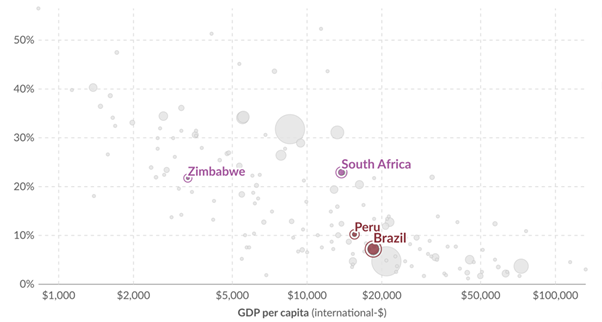
South Africa’s food story is one of abundance shadowed by avoidable tragedy. Devastatingly, in this year alone, 155 children under the age of five have died from moderate or severe acute malnutrition as an underlying condition in public health facilities (Parliamentary Monitoring Group, 2025). As the most food-secure country in sub-Saharan Africa according to the Global Food Security Index, and a major food exporter, South Africa should be able to nourish its own people. Instead, South Africa’s child stunting rate remains alarmingly high for an upper-middle-income country, with 22.8% of children under the age of five classified as stunted in 2022.
In contrast, Brazil and Peru, both with GDPs per capita comparable to South Africa, record stunting rates of 7.2% and 10.1% respectively. South Africa’s stunting prevalence is on par with that of Zimbabwe (21.6%), despite South Africa having a substantially higher GDP per capita. This disparity highlights a serious disconnect between economic status and public health outcomes, suggesting that national income alone is not translating into improved nutrition and development. While this can largely be attributed to high levels of unemployment and therefore a lack of income at the household level, South Africa’s social grant system should provide a meagre safety net in this regard (although the gap between the CSG and the food poverty line is still significant). So, where are we going wrong?
Figure 1: Share of children who are stunted
Source: Our World in Data
Malnutrition is not merely a symptom of poverty; it is also a driver of it. Undernutrition during pregnancy and early childhood leads to lasting physical and cognitive impairments, which in turn reduce educational attainment, earnings, and long-term wellbeing. As Nisbett et al. (2014) argue, “undernutrition is not only one of the key physical manifestations of poverty but is also one of the key mechanisms by which poverty, and its consequences, are transmitted intergenerationally” (emphasis added). UNICEF’s conceptual framework helps unpack why.
Figure 2:UNICEF’s conceptual framework of malnutrition

Source: Strategy for improved nutrition of children and women in developing countries. UNICEF, New York, June 1990
At the most immediate level, an individual’s diet must supply sufficient calories and a balanced mix of nutrients, yet even an adequate intake cannot guarantee good nutrition if illness prevents the body from absorbing what is eaten. Underlying these immediate drivers are three core conditions set out in UNICEF’s conceptual framework: food security, care practices and health services (Nisbett, Gillespie, Haddad, & Harris, 2014). Food security depends on steady access to land, water, income and markets; without these, households cannot obtain or grow sufficient, diverse foods. Care encompasses breastfeeding, complementary feeding and wider childcare practices that determine whether infants and young children receive the nutrients they need when growth is most rapid. Health services, including vaccinations and water, sanitation and hygiene (WASH) services are essential for preventing the infections that drain nutrients and decrease appetite.
Finally, the underlying causes of malnutrition are driven by the basic causes of malnutrition: the social, economic and political factors which determine a household’s access to the resources discussed above. In short, these basic causes, the structure of the economy and its interaction with political and ideological factors can be understood as the political economy of malnutrition. And, it is here, where the rest of this blog will focus. More specifically, this blog highlights the development and structure of South Africa’s agri-food system: the combination of activities and actors involved in the production and consumption of a particular food item (Ledger, 2016). I argue that to attribute the urgent crisis of hunger in our country to unemployment and lack of income alone obfuscates the role of political economy – it neglects to consider the structure of our agri-food system and, more specifically, the role of food processors and retailers in this crisis. To understand the role of food processors and food retailers in South Africa’s agri-food system, however, it is worth taking note of how this sector is structured.
The structure of South Africa’s agri-food system
South Africa’s agri-food system mimics the characteristics of industrialised and more developed countries around the globe in that it is can be understood as a corporate agri-food system. Briefly, a corporate agri-food system involves the growing dominance of large corporations across the value chain, an increase in processed food sales, the rise of supermarket retail formats, and a widening gap between producers and consumers (Ledger, 2016).
South Africa’s food system is highly concentrated across the value chain. In 2017, 67% of income in South African agriculture was earned by 6.5% of total farms (Cousins, 2020). Additionally, four companies held around 54% of the cattle feedlot market share in 2010 (Greenberg, 2017) while two companies accounted for 90% of the wheat, maize and sorghum seed market ((Hall and Cousins (2018) in (Adeniyi, Losch, & Adelle, 2021)). However, concentration is most pronounced in food processing and retail – with market shares of the most dominant enterprises being double the global average (FAO, 2022). South Africa’s food retail sector is dominated by four companies (Shoprite, Pick n Pay, Spar and Woolworths) that make up roughly 72% of the market share ( Competition Commission, 2019).
Since 2011, food prices in South Africa have consistently exceeded overall inflation. a divergence that intensified early in the COVID-19 pandemic and has scarcely narrowed (FAO, 2022). Between 2011 and 2023, the annual food inflation rate was 6,8%, compared to 5,2% for headline inflation (DPRU, 2024). Because household food expenditures are regressive, this places disproportionate strain on poor households. The poorest 40% of households spend approximately 30% of their incomes on food – making it the largest category of household expenditure for poor households, compared to 5.8% for the richest decile of households (DPRU, 2024). Poor households are thus more vulnerable to food price fluctuations, which has had implications for household food security over the long-term.
A primary contributor to elevated food costs is the mark-up strategies of a concentrated retail sector. Research indicates that average food mark-ups have increased by around 25 per cent annually (well above comparable emerging markets) and these increases are driven largely by dominant supermarket chains rather than by higher input costs ((Dauda, Nyman & Cassim 2019) in (FAO, 2022)). The collusive power of the retail sector is not new; some might recall the bread price fixing scandal of the early 2000s where the Competition Commission found that between 1994 and 2006, Pioneer Foods, Tiger Brands and Premier Foods increased bread prices by similar amounts at or about the same time. Since then, the Commission has also imposed sanctions on processed-food cartels and identified preferential trading arrangements that disadvantage smaller suppliers (FAO, 2022). While headline inflation was cooling towards the end of 2024, the Commission warned that major retailers were not lowering shelf prices quickly enough to match falling input costs, highlighting eggs, sunflower oil and bread as staples where mark-ups remained stubbornly high (Wilson, 2024).
Compounding the issue is the growing price gap between nutrient-dense and energy-dense, processed foods. Highly processed products remain relatively affordable and are heavily promoted via billboards, television and even within schools, while fresh fruit, vegetables and other nutrient-dense items have become disproportionately expensive (FAO, 2022). This dynamic compels low-income consumers to opt for cheaper, less nutritious options, thereby exacerbating malnutrition in vulnerable communities.
Moreover, the rise of large shopping centres – often referred to as “mallification” – alters urban planning in ways that marginalise informal traders and redirect consumer footfall away from neighbourhood spaza shops (Battersby, 2017). By shaping transport routes and commercial zoning to favour enclosed malls, retail concentration further restricts market access for small-scale farmers and informal vendors, reinforcing barriers to affordable food.
Following poor regional performance, South African supermarket chains have turned to low-income rural and township customers usually served by informal traders (Bowman, 2025). This strategy began around 2009 and has expanded with the roll-out of hard-discount stores like Shoprite’s USave and Pick n Pay’s Boxer. Although separate financial reports aren’t published, company statements show these formats perform well (Bowman, 2025). Shoprite previously noted that its USave stores achieved a return on invested capital of around 30%, while Pick n Pay reported a 20% ROIC for Boxer; notably higher than their respective overall group ROICs of approximately 20% and 17% (Bowman, 2025). Boxer has been highlighted as Pick n Pay’s most financially successful division and both chains have prioritised these formats in their capital investment strategies. When supermarkets expand to the extent that they limit the ability of small or informal retailers to operate, this leads to reduced food security of the poorest households who primarily rely on informal food retailers.
Policy responses to our agri-food system
The lack of attention paid to the political economy of South Africa’s agri-food system has translated into a food policy environment with little imagination for alternatives. The National Food and Nutrition Security Plan (NFNSP) has faced critique for its narrow focus on food production, overlooking the broader food system that shapes how South Africans access and consume food. An evaluation of the Plan highlights limited engagement the informal food sector; a key element in the day-to-day reality of many households (DPME, 2023). Despite alluding to the wider food system, the Plan makes little to no mention of the private sector and its involvement in the food system. The plan leaves the structure of corporates untouched and envisions the mitigation of food insecurity to come from the increased inclusion of smallholder farmers who face significantly high barriers to entry in our highly concentrated agricultural sector.
Even more concerningly, however, research has underscored a lack of political will when it comes to solving the crisis of hunger in South Africa (Devereux, Haysom, Maluf, & Scott-Villiers, 2022). With respect to the NFNSP, the evaluation found that the National Council on Food and Nutrition Security had not been created (DPME, 2023). By choosing an unpaid, volunteer-only membership model without any dedicated secretariat, Government signalled that the Plan’s implementation is a low priority. This inertia contrasts sharply with other sectoral bodies, like the South African National Aids Council, which operate with funded, remunerated boards and clear accountability frameworks that ensure sustained engagement and action.
Normalising hunger in a country of plenty is a policy choice. South Africa needs government to treat the elimination of hunger as urgent and to tackle the political economy of its food system head-on. That means competition policy with teeth, incentives that favour nutrient-rich foods, support for informal and small-scale traders, and governance structures that bring corporate power under scrutiny.
References
Competition Commission. (2019). The Grocery Retail Market Enquiry: Final Report. Retrieved from https://www.compcom.co.za/wp-content/uploads/2019/12/GRMI-Non-Confidential-Report.pdf
Adeniyi, D., Losch, B., & Adelle, C. (2021). Investigating the South African Food Insecurity Paradox: A Systematic Review of Food System Governance in South Africa. Food Security SA Working Paper Series.
Battersby, J. (2017). Food system transformation in the absence of food system planning: The case of supermarket and shopping mall retail expansion in Cape Town, South Africa. Built Environment, 417-430. doi:https://doi.org/10.2148/benv.43.3.417
Bowman, A. (2025). upermarketisation, agro-industrial concentration and the food system’s shrinking interstices: Insights from South African agro-processing. Global Networks: A Journal of Transnational Affairs, 25(2), 1-16. doi:https://doi.org/10.1111/glob.12521
Cousins, B. (2020). Problematic assumptions raise questions about South Africa’s new land reform plan. Retrieved from Institute for Poverty, Land and Agrarian Studies: https://plaas.org.za/problematic-assumptions-raise-questions-about-south-africas-new-land-reform-plan/#:~:text=A%202017%20census%20of%20commercial%20farming%20revealed,annually%20or%20below%20number%2025%2C000%2C%20or%2062
Devereux, S., Haysom, G., Maluf, R., & Scott-Villiers, P. (2022). Challenging the Normalisation of Hunger in Highly Unequal Societies. Brighton: Institute of Development Studies. doi:DOI: 10.19088/IDS.2022.086
DPME. (2023). Implementation Evaluation of the National Food and Nutrition Security Plan. Retrieved from https://www.dpme.gov.za/keyfocusareas/evaluationsSite/Evaluation%20Reports/Genesis%20DPME%20NFNSP%20Full%20Evaluation%20Report%2002.11.2023.pdf
DPRU. (2024). Trends in the Cost of Living in South Africa. Development Policy Research Unit. National Planning Commission. Retrieved from https://www.nationalplanningcommission.org.za/assets/Documents/Trends%20in%20the%20Cost%20of%20Living%20Research%20Report%2025%20November%202024.pdf
FAO. (2022). Food Systems Profile – South Africa: Catalysing the sustainable and inclusive transformation of food systems. Food and Agriculture Organization of the United Nations, e French Agricultural Research Centre for International Development, European Union. doi:https://doi.org/10.4060/cc0071en
Greenberg, S. (2017). Corporate power in the agro-food system and the consumer food environment in South Africa. The Journal of Peasant Studies, 44(2), 467-496. doi:https://doi.org/10.1080/03066150.2016.1259223
Kushitor, S., Drimie, S., Davids, R., Delport, C., Hawkes, C., Mabhaudhi, T., . . . Pereira, L. (2022). The complex challenge of governing food systems: The case of South African food policy. Food Security, 14, 883–896. doi:https://doi.org/10.1007/s12571-022-01258-z
Ledger, T. (2016). Power and Governance in Agri-Food Systems: Key Issues for Policymakers. Trade and Industrial Policy Strategies. Retrieved from https://www.tips.org.za/research-archive/trade-and-industry/item/317
Nisbett, N., Gillespie, S., Haddad, L., & Harris, J. (2014). Why Worry About the Politics of Childhood Undernutrition? World Development , 64, 420-433.
Parliamentary Monitoring Group. (2025, May 6). Question NW1985 to the Minister of Health. Retrieved from Parliamentary Monitoring Group: https://pmg.org.za/committee-question/29572/
Wilson, N. (2024, October 6). Retailers not cutting food prices fast enough – especially eggs, competition watchdog warns. Retrieved from News24: https://www.news24.com/business/companies/retailers-not-cutting-food-prices-fast-enough-especially-eggs-competition-watchdog-warns-20241006