

South Africa aims to leverage its green economy to emerge as a leader in sustainable economic development. Building up to the G20 Summit to be hosted in South Africa in November 2025, President Cyril Ramaphosa has highlighted the country’s vision of “environmental stewardship, economic advancement, and social equity, positioning South Africa as a key player on the global stage” (Brand South Africa, 2025). These goals are not without action, as efforts towards greening the country’s economy over the last decade have provided opportunities for success, such as through the rapid development of the country’s renewable energy sector (Ritchie, 2025).
A key requirement for the further development of the South African green economy is the promotion of green trade.
International trade plays a critical role in enabling sustainable industrialisation. As outlined in national frameworks such as the National Development Plan (NDP), New Growth Path (NGP), Industrial Policy Action Plan (IPAP), and the South African Trade Policy and Strategy Framework (SATPSF), trade is a key driver of industrial productivity. On the demand side, it opens access to broader markets, reducing reliance on domestic demand and allowing businesses to grow beyond national borders. On the supply side, trade can stimulate local production by replacing imports, while also fostering greater competitiveness and innovation through exposure to international standards and technologies. (Sako, Maliaga, & Obinyeluaku, 2021)
How has South Africa performed in the incorporation of environmentally sustainable products and practices in its international trade, and what can be done to improve this going forward?
Measuring green trade
International trade can promote green growth by facilitating the exchange of “green” goods, services and technologies; and enabling access to and the more efficient deployment of sustainable practices. Ideally, increased “green trade” would accelerate our transition to a sustainable green economy.
“Green growth” is widely understood as a path to economic development that maintains environmental sustainability. While definitions may differ, the overall message of its importance is clear; from the World Bank Group’s description of green growth (World Bank Group, 2012) to the South African government’s definition of the country’s green economy (DFFE, 2025), green growth directly ties into multiple Sustainable Development Goals (UN, 2025) and is key for a sustainable future.
What is green growth?
There is no globally accepted definition of green trade, and similarly, there is no globally accepted measurement of a country’s green trade. Several international institutions have developed or are in the process of developing classifications and indicators for tracking and assessing trade in environmental goods and services, such as the OECD, APEC, EU, and WTO. (Reinsch, Benson, & Puga, 2021)
The OECD’s 1999 definition of environmental goods and services is reportedly regarded as a complete definition. However, it is considered more conceptual than practical, with trade in over 400 products tracked. Similarly, the EU’s 2016 definition of environmental goods does not offer a good practical measurement mechanism. On the other hand, the 2012 APEC list of environmental goods provides a narrower list of traded goods and is touted as the “world’s preeminent agreement of liberalizing the trade of environmental goods”. (Reinsch, Benson, & Puga, 2021)
APEC (Asia-Pacific Economic Cooperation), established in 1989, is a regional economic forum consisting of 21 members which aims to promote regional prosperity (APEC, 2025). In 2012, APEC developed and endorsed a list of 54 “Environmental Goods” with the commitment to reduce the tariff rates applied on these goods to 5% by 2015. The initiative aimed to facilitate access to and the use of environmental technologies, with the listed products thought to “directly and positively contribute to green growth and sustainable development objectives”. (APEC, 2012; Kuriyama, 2022)
The list of “Environmental Goods” (EGs) was developed through APEC member nations’ discussions, nominations, and analysis to reach a consented list. The overall distribution of the list by Product Category, as provided by APEC, is presented in Table 1.
Table 1: Distribution of the APEC EG List by Product Category
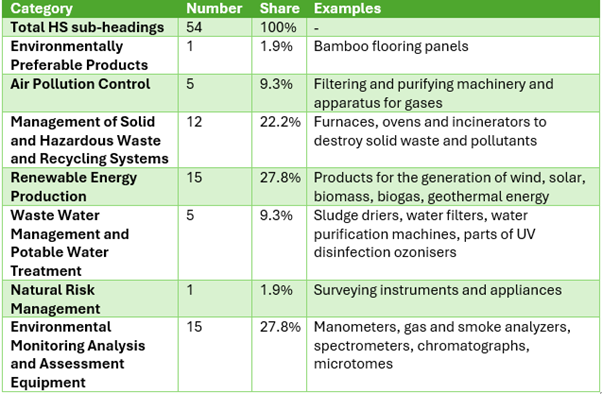
Source: (Kuriyama, The APEC List of Environmental Goods, 2012)
Global trade in EGs
From 2012-2021, global trade of products on the APEC EG list grew by 7.3%, peaking in 2019 before the COVID-19 pandemic. This strong performance of global trade in environmental goods is reportedly due to: (Kuriyama, 2022)
- Environmental technologies becoming more affordable;
- Improved environmental awareness, leading to increased use of environmentally friendly products;
- The instability and recent upward trend in oil prices;
- Improved incentives for the development of sustainable energy sources and energy-efficient goods; and
- Government regulations implemented for the protection of the environment.
Following the strong performance of the APEC EGs in global trade over the past decade, calls have been made for the expansion of the list to include additional goods. (APEC Policy Support Unit, 2021)
South Africa’s trade in EGs
Based on the APEC EG list, South Africa’s trade performance in such goods can be measured.
Figure 1 shows South Africa’s imports and exports of the products listed in the APEC EG list and the resulting trade balance from 2013-2024[1]. Both the country’s overall imports and exports of environmental goods have decreased relatively consistently and gradually, resulting in its total trade of EG goods almost halving (declining by 47.12% since 2013). The country’s trade balance in EG goods improved until 2021, with exports exceeding imports in 2018, 2020, and 2021. However, since 2022, the country’s imports of EG have continued to exceed its exports.
These figures suggest that, based on South Africa’s exports and imports of the APEC EG goods, the country has been involved in less green trade since 2013 (in value terms) (barring a spike in 2021, most likely driven by a rebound in post-pandemic trade). The data also indicates that South Africa has become marginally more dependent on imports of EGs over the last few years, though this is largely due to the continued decline in the country’s exports.
Figure 1: South African trade in APEC Environmental Goods (2013-2024) (US$, billions)
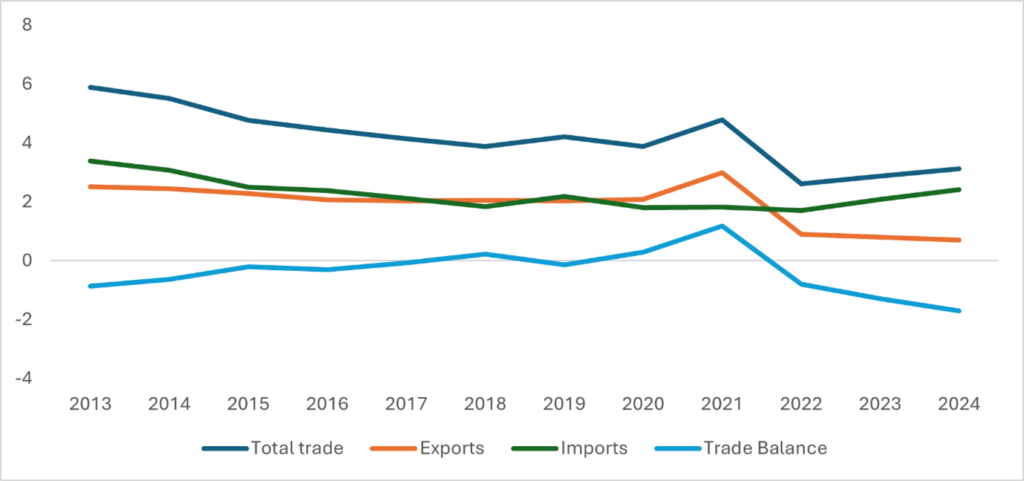
Source: Analysis from UN Comtrade Database
South Africa’s transition towards a green economy has historically been supported by imports of renewable energy technology. In the short term, it is crucial that the country continues to draw on international expertise and innovations. In the longer term, this will enable South Africa to develop a greener growth, including the manufacturing and exporting of green products. This will require supportive government trade and industrial policies, and collaboration between public and private parties to encourage investment in research and development. (PAGE, 2018)
Top traded EGs
Taking a closer look at South Africa’s trade in the specific products on the APEC EG list provides deeper insights into which products drive imports/exports of green goods, and which products have seen significant increases or decreases in their trade since 2013. Table 2 provides the top 10 exported EG products as a share of South Africa’s total EG export value from 2013-2024, while Table 3 provides the same for its imports.
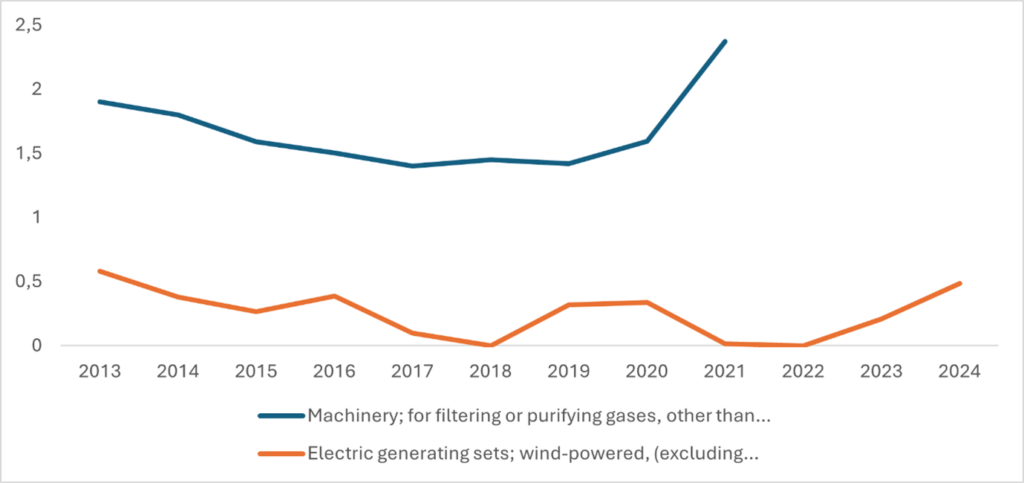
Over these years, South Africa’s exports of “Machinery; for filtering or purifying gases, other than intake air filters for internal combustion engines” (classified under six-digit HS code 842139) made up 65.79% of its total EG exports. As shown in Figure 2, from 2013-2024, South Africa’s exports of the product declined until 2017, with a sharp upturn seen from 2019-2022. South Africa’s exports of this product saw an annual increase of 48.76% from 2020-2021.
Based on the eight-digit HS code breakdown and other product information provided on the APEC EG list, the products under this category mostly consist of a range of gas filtering and purifying machinery, such as catalytic converters, dust collection systems, air purifiers, and laminar flow units. Considering the extent to which these products have dominated South Africa’s EG export basket, the country’s green trade is susceptible to fluctuations in the demand for these products. Global trends, such as the shift to electric vehicles (EVs) and subsequent reduced demand for catalytic converters, may significantly influence global demand for and thus trade in these products.
Table 2: Top 10 EG exports (as a % of total exports from 2013-2024)
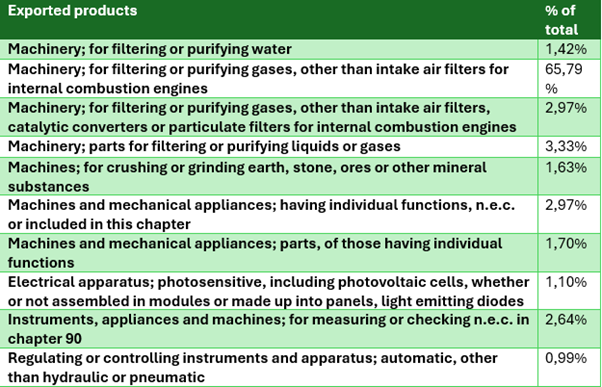
Source: Analysis from UN Comtrade Database
South Africa’s imports of EG products are more evenly distributed, with the top 10 products each making up 3.15%-11.28% of the country’s total EG imports from 2013-2022. The top imported product is “Electric generating sets; wind-powered, (excluding those with spark-ignition or compression-ignition internal combustion piston engines)” (classified under six-digit HS code 850231).
Table 3: Top 10 EG imports (as a % of total imports from 2013-2022)
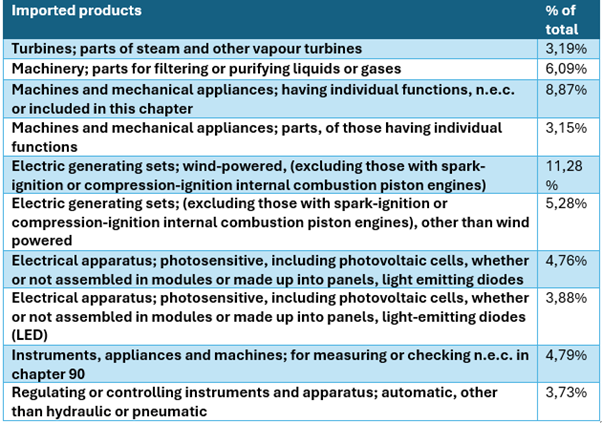
Source: Analysis from UN Comtrade Database
Figure 2 shows that imports of this product declined from 2013-2022, though there has been a recent uptick in import activity. This trend mirrors South Africa’s investment in renewable energy production and imports can be expected to rise further in the coming years.
Figure 2: South African top EG exported and imported products from 2013-2024 (US$, Billions)
Source: Analysis from UN Comtrade Database
Improving green trade
South Africa’s trade in the APEC list of environmental goods has been disappointing over the last few decades, though recent trends suggest some promise. The country’s improving trade balance from 2013-2021 suggested a growing self-reliance and potential in local green manufacturing, but these gains have since been undone.
From an initial analysis, the country’s EG exporting basket is heavily concentrated in Machinery; for filtering or purifying gases, other than intake air filters for internal combustion engines, which includes many products that are highly vulnerable a global shift away towards electric engines. Therefore, options for diversifying the country’s EG export basket must be explored.
Conversely, a large share of South Africa’s imports are linked to the country’s renewable energy programmes. An increase is needed to strengthen South Africa’s production of green energy. For long-term sustainability, both improved importing and exporting of green goods are required to support and promote the development of internal green capacity.
To further strengthen South Africa’s green growth trajectory, its trade and industrial development strategies should be more explicitly aligned with the country’s broader sustainable development and economic goals. For instance, linking green industrialisation efforts to SDG 9 (which promotes sustainable industry, innovation, and infrastructure) could better position the country’s green trade agenda within its sustainable development goals. Additionally, South Africa’s national strategies, such as the Just Energy Transition (JET) strategy, which aims to achieve a low-carbon, inclusive energy future, present a timely opportunity to grow domestic green manufacturing capabilities (The Presidency, 2025). By integrating such national strategies with international trade goals, South Africa can improve its trade in environmental goods, fostering a resilient green economy that is not only environmentally sustainable but also globally competitive.
Finally, this analysis of South Africa’s trade in the APEC list of EGs also reveals a wider need to revisit and evaluate what products should qualify as environmental goods in 2025. The same factors which contributed to the initial success of the APEC EG products in global trade[2] have led to the rapid development of many new green products and services over time. As a result, countries’ trade in the APEC EG products may no longer provide an accurate indication of their green trade, with a revision and potential expansion of the list necessary in order to monitor South Africa’s future performance.
[1] The UN Comtrade dataset of South African trade, disaggregated by all 6-digit HS commodities, appears to have missing values for the exports and imports of various products in certain years. Therefore, this analysis should be viewed as a high-level investigation into the trends of South Africa’s green trade.
[2] Affordability of environmental technologies, improved awareness and practices, oil price changes, improved incentives for green development, and the implementation of government regulations.
References
APEC. (2012). ANNEX C – APEC List of Environmental Goods. Retrieved from Asia-Pacific Economic Cooperation: https://www.apec.org/meeting-papers/leaders-declarations/2012/2012_aelm/2012_aelm_annexc
APEC. (2025). What is Asia-Pacific Economic Cooperation? Retrieved from APEC: https://www.apec.org/about-us/about-apec
APEC Policy Support Unit. (2021). Expanding the APEC List of Environmental Goods List to Fight Climate Change: Analysis. Retrieved from APEC: https://www.apec.org/press/news-releases/2021/expanding-the-apec-list-of-environmental-goods-list-to-fight-climate-change-analysis
Brand South Africa. (2025). Investing in the Green Economy: South Africa’s Blueprint for Climate Leadership and Sustainable Development. Retrieved from Brand South Africa: https://brandsouthafrica.com/176315/technology-innovations/investing-in-the-green-economy-south-africas-blueprint-for-climate-leadership-and-sustainable-development/
DFFE. (2025). About Green Economy. Retrieved from Department of Forestry, Fisheries and the Environment: https://www.dffe.gov.za/about-green-economy
Kuriyama, C. (2012). The APEC List of Environmental Goods. APEC.
Kuriyama, C. (2022). Experiences of APEC economies with trade in environmental goods and services. APEC .
Kuriyama, C. (2022). Time to expand the APEC List of Environmental Goods. Retrieved from Asia-Pacific Economic Cooperation: https://www.apec.org/press/blogs/2022/time-to-expand-the-apec-list-of-environmental-goods?utm_source=chatgpt.com
PAGE. (2018). A GREEN ECONOMY INDUSTRY AND TRADE ANALYSIS: ASSESSING SOUTH AFRICA’S POTENTIAL. Department of Environmental Affairs.
Reinsch, W. A., Benson, E., & Puga, C. (2021). Environmental Goods Agreement: A New Frontier or an Old Stalemate? Retrieved from CSIS: https://www.csis.org/analysis/environmental-goods-agreement-new-frontier-or-old-stalemate
Ritchie, H. (2025). South Africa: Energy Country Profile. Retrieved from Our World In Data: https://ourworldindata.org/energy/country/south-africa
Sako, C., Maliaga, L., & Obinyeluaku, M. (2021). Trade as a driver of manufacturing structural change for sustainable development in South Africa. Researchgate.
The Presidency. (2025). South Africa’s Just Energy Transition. Retrieved from Just Energy Transition: https://justenergytransition.co.za/
UN. (2025). THE 17 GOALS. Retrieved from United Nations: https://sdgs.un.org/goals
World Bank Group. (2012). Inclusive Green Growth – FAQ. World Bank Group.