

Concerns about the effectiveness of South Africa’s public institutions are longstanding, yet they have intensified in recent years. Service delivery challenges, energy crises, and fragmented governance structures have exposed the country’s struggles to address critical problems in a timely, coordinated way. Many attribute these challenges to weak state capacity – an issue shaped not just by insufficient funding or outdated and mismanaged infrastructure, but also by a lack of clearly defined and sustained priorities.
State capacity and capability is a broad topic – including the judicial framework and robust human resource management, all of which cannot be addressed in one post. This blog focuses on the evolving role of the state – what it should be doing and how it should do it. There is a growing school of thought that seeks to reimagine public sector operations, sparking a conversation on how this could de done in South Africa.
A Brief History: New Public Management and the changing role of the state
To understand this new (or renewed) conversation on state capability, it helps to begin by recalling how governments were commonly viewed a few decades ago, especially under the paradigm of “New Public Management” (NPM). Emerging in the 1980s and 1990s, NPM was heavily influenced by market-oriented principles, emphasising efficiency, competition, and cost-cutting in the public sector. Under this approach, governments were encouraged to adopt the language and practices of private businesses; words like “performance targets” and “outsourcing” became hallmarks of public-sector reform (Therkildsen, 2001). Through NPM, the state’s role was cast primarily as a facilitator or regulator, rather than an active driver of innovation. While NPM helped streamline certain government functions, it also narrowed the public sector’s outlook, limiting some visions of what governments can achieve in terms of large-scale social transformation.
In contrast to this, Mariana Mazzucato’s work argues that states should reclaim their role as entrepreneurial risk-takers and creators of value. However, she is far from alone in this viewpoint. Other scholar have similarly argued that a proactive state can drive economic development by nurturing strategic industries (Weiss, 1998).
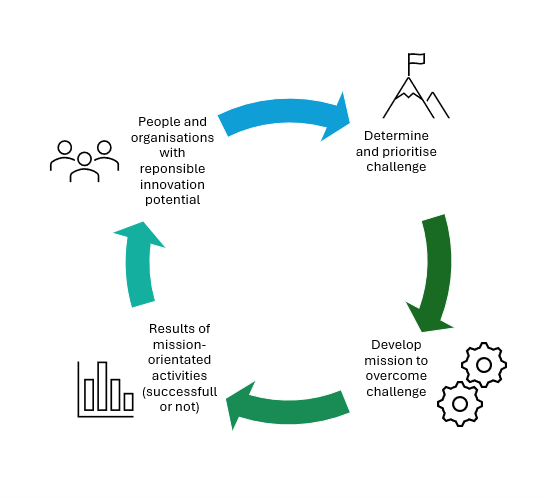
At its core, a “mission-oriented economy” encourages governments to identify big, bold challenges – often spanning multiple sectors – and then galvanise public agencies, private firms, universities, and civil society to collaborate on achieving those missions. Rather than merely regulating the market, the state sets long-term objectives (like significantly reducing greenhouse gas emissions) and strategically directs resources, policies, and partnerships to meet those goals (Mazzucato, 2018). The payoff is a more dynamic form of innovation, where both risks and rewards are shared among all who contribute.
“Policy is not just about ‘intervening’. It is about shaping a different future: co-creating markets and value, not just ‘fixing’ markets or redistributing value. It’s about taking risks, not only ‘de-risking’. And it must not be about levelling the playing field but about tilting it towards the kind of economy we want.” – Mariana Mazzucato, Mission Economy: A Moonshot Guide to Changing Capitalism
For those sceptical about the state’s capacity for genuine innovation, the iPhone’s evolution offers a powerful example. Many of its core technologies – including the internet, GPS, and touchscreen interfaces – emerged from US government agencies, demonstrating how public investment has long guided and shaped major breakthroughs. Far from merely financing core research, the public sector created a “developmental network state,” providing early-stage funding, fostering collaborations among diverse actors, and using targeted tax credits to usher cutting-edge inventions toward commercial viability (Block and Keller, 2011).
Figure 1: State investments that make up the key technologies behind the iPhone

Source: Mazzucato, 2013
By steering strategic investments – for instance, in renewable energy or advanced healthcare – the public sector can spark entirely new types of markets and shape how society pursues common objectives. Because states often finance the earliest and riskiest stages of research and development, they should design mechanisms that ensure rewards are fairly distributed; this might include revenue-sharing agreements or clauses that direct profits from publicly funded discoveries back into additional innovation or social programmes. Above all, the mission-oriented economy hinges on dynamic capabilities, meaning governments must recruit skilled professionals, invest in ongoing training, and allow public institutions the freedom to experiment, learn from mistakes, and adapt effectively.
“Never let a good crisis go to waste” – Winston Churchill
This approach has been clearly demonstrated in recent years. The COVID-19 pandemic, for instance, showed just how critical effective states are to coordinating rapid vaccine development, managing healthcare capacities, and guiding economic support mechanisms. Rather than simply “getting out of the way” of markets, governments worldwide had to set clear objectives and orchestrate multi-stakeholder efforts under immense pressure. South Africa was a great example of this; President Ramaphosa’s administration secured multi-partner agreements to procure and distribute vaccines, partnering with private healthcare providers and international organisations to expedite rollout. But governments shouldn’t only take up this role in times of a global crisis. Plus, it could be argued that there are multiple domestic crises that deserve similar cross-cutting approaches. States that proactively define missions can harness their capacity and ability to integrate a variety of players for long-term developmental goals.
South Africa’s ongoing crises – loadshedding, high unemployment, and limited institutional capacity – call for a more cohesive, strategic approach. Given that Mazzucato has been selected to sit on President Ramaphosa’s economic advisory committee (BusinessTech, 2024), it is worthy to consider how this approach could work in South Africa. One example, for instance, lies in the potential for a “Just Energy Transition” mission (Mazzucato, Kattel, & Qobo, 2021):
A ‘Just Energy Transition’ mission – Loadshedding and climate change concerns underscore the importance of a resilient, equitable energy system. South Africa could adopt a mission to prioritise a just transition to renewable energy by 2035.
- Government departments, Eskom, private energy producers, and universities would collaborate to develop pilot projects in solar, wind, and hydrogen power.
- Financing instruments could be aligned to foster local manufacturing and R&D hubs around renewable technologies.
- Skills-building programmes in affected provinces (e.g., Mpumalanga with its coal-dependent economy) would be prioritised, ensuring that communities are not left behind in the shift.
Dynamic capabilities in public institutions: A major obstacle in South Africa remains fragmented governance and a shortage of skilled personnel in key public institutions. But there is some work being done in this space – reference to the public service commission and other examples where capacity is being developed – Perhaps the biggest challenge is sustaining political attention and leadership over the long term. Even the most well-designed plan can falter if leadership changes every few years and priorities shift dramatically. As such, creating cross-party alliances or stakeholder coalitions around missions (e.g., for the just energy transition) can reduce the risk that efforts get derailed when political winds change.
Figure 2: Responding to challenges
Source: The Commonwealth Scientific and Industrial Research Organisation Australia
Real hurdles to implementing a mission-oriented framework
Of course, adopting this approach is easier said than done. South Africa’s history of inequality, corruption, and resource constraints means that implementing such a framework would face real hurdles. Some of the biggest include:
Skills shortages and brain drain: The public sector needs strong technical and managerial skills. Retaining talent is critical, but many professionals may be drawn to private or global institutions offering better pay and resources.
Institutional silos: Coordination between local, provincial, and national government is very challenging. Breaking down silos and aligning different levels of authority requires structural reform, clarity of mandate, and shared incentives.
Funding gaps: Mission-oriented policies often require substantial upfront investment, with payoffs potentially years away. Public officials may need to justify why public funding matters today for future growth, particularly to a sceptical electorate or to budget-constrained treasuries.
Revitalising state capacity is key to South Africa moving beyond a piecemeal, reactive approach to pursuing development priorities. As global challenges have multiplied, simply making the state “leaner” or more “business-like” is no longer sufficient. What’s needed is a state that commits to prioritisation and planning, high-calibre public leadership, and collaborative partnerships that distribute both risks and rewards fairly.
References
Block, F. and Keller, M. (2011). State of Innovation: the U.S. Government’s Role in Technology Development. Boulder: Paradigm.
BusinessTech (2024) Meet Ramaphosa’s new top economic advisors. Available at: https://businesstech.co.za/news/government/800729/meet-ramaphosas-new-top-economic-advisors/
Mazzucato, M., Kattel, R. & Qobo, M. (2021) The Case of South Africa: Building State Capacities and Dynamic Capabilities to Drive Social Change. UCL Institute for Innovation and Public Purpose. Available at: https://www.ucl.ac.uk/bartlett/public-purpose/sites/public-purpose/files/final_the_case_of_south_africa_mazzucato_kattel_qobo_21-09.pdf
Mazzucato, M. (2018). Mission-oriented research & innovation in the European Union: A problem-solving approach to fuel innovation-led growth.
Therkildsen, 0. (2001). Efficiency, Accountability and Implementation. Public Sector Reform in East and Southern Africa.
Weiss, L. (1998). The myth of the powerless state: Governing the economy in a global era. Cornell University Press.