

The past six months have been a journey of personal growth and discovery. I have been involved in projects that explore the financial state of South Africa’s municipalities. Municipalities are a crucial platform for transforming the lives of ordinary South Africans, yet are often constrained by governance, financial, and capacity challenges. Navigating this space was a steep learning curve: unfamiliar, at times overwhelming, yet incredibly rewarding. Engaging with key stakeholders across both the public and private sectors has deepened my understanding of the complexities of local governance in a way that theory alone never could. Perhaps this discomfort and learning are what growth truly feels like.
The situation is not improving but deteriorating
A key insight from this work is that the situation in many municipalities is not improving but deteriorating. Intermediate cities, specifically, are struggling to perform even the most basic functions, such as collecting revenue, maintaining infrastructure, and delivering services reliably. By 30 June 2022, consumers owed municipalities R255.4 billion, almost double the R128 billion owed the previous year. Between 2017/18 and 2021/22, total debt increased by 78.4%, driven by unpaid municipal services, VAT receivables, and billing errors.[1] Despite consistently recognising revenue collection as a critical issue, most municipalities have made little progress in this area. In 2022/23, the declining state of local government finances and financial management became more evident, with the number of municipalities in financial distress increasing from 157 in 2021/22 to 168.[2]
The 2023/24 local government audit outcomes reflect the continued struggle with poor performance and weak financial management across many municipalities. Of the 247[3] municipalities audited, only 41 (16%) achieved clean audits, a slight improvement from the previous year, but no progress from the 2020/21.[4] While 59 municipalities have improved their audit outcomes since 2020/21, 40 have regressed, indicating ongoing instability in financial governance. Since 2021/22, municipalities have incurred R17.65 billion in fruitless and wasteful expenditure.
Professionalising local government: a critical turnaround for South Africa
In the 2020 State of the Nation Address (SONA),[5] the government acknowledged the importance of strengthening local government as a foundation for a capable and developmental state. It pledged to attract skilled professionals through a graduate recruitment scheme and to ensure service delivery improvements in towns and cities where roads were crumbling, refuse went uncollected, and basic services like water and electricity were unreliable. Five years later, in SONA 2025,[6] these promises were reiterated, with commitments to establish professionally managed, ringfenced utilities to improve infrastructure investment and service delivery. Despite repeated recognition of the crisis, the situation continues to deteriorate.
Operation Vulindlela (OV) Phase II[7] again identified failing local governance as a major constraint on investment and growth, citing financial distress, governance instability, and service delivery failures in most municipalities. OV Phase II rightly emphasises reforms to standardise and professionalise the appointment of senior officials, enforce minimum competency standards for municipal managers and Chief Financial Officers (CFOs), and expand the Public Service Commission’s oversight to local government.
South Africa’s local governance failures have been acknowledged in speech after speech. What is clear is that the crisis is not due to a lack of understanding or policy clarity; it is a failure of political will and institutional follow-through. This is no longer a matter for policy speeches, but a crisis that requires urgent and decisive action that holds leadership accountable and delivers change where it matters the most, in communities.
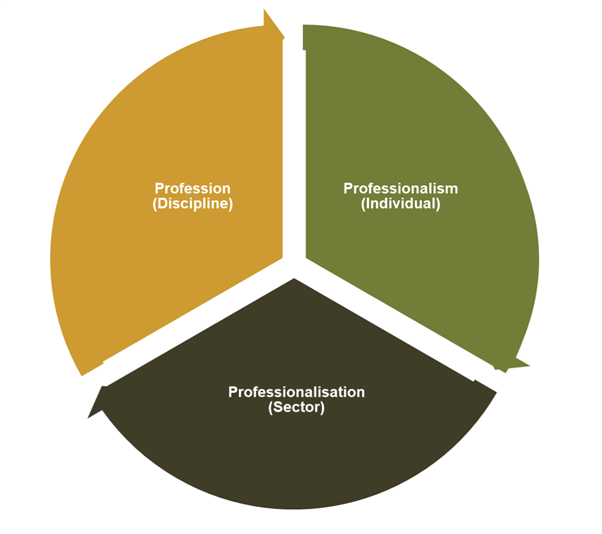
A critical part of the solution lies in professionalising local government. The Framework for the Professionalisation of the Public Sector rightly calls for a shift beyond qualifications to values, ethics, and continuous capacity building.[8] Professionalising the public sector requires a shift towards instilling core public service values, such as integrity, ethical conduct, and a commitment to continuous learning.[9] This ensures that public servants are not only technically competent but also dedicated to excellence in service delivery and to acting in the public interest. Figure 1 shows the Framework’s approach to professionalising the public sector.
Figure 1: Approach to professionalising the public sector
What the Framework also makes clear is that academic qualifications alone are not sufficient for public servants. It must fundamentally change how individuals enter, work within, and are held accountable in the public service. This includes the introduction of pre-entry exams, integrity assessments, and a shift towards a non-partisan, merit-based recruitment system. These steps would ensure that those who join the public service understand from the outset the ethical responsibilities and standards expected of them. How individuals are selected and socialised into public institutions shapes how they see their roles, not as extensions of political influence, but as custodians of public trust.
Equally important is the institutional entry culture: how people are recruited, what values are emphasised, and how they are prepared to make decisions independently of political or personal pressures. There must be a clear understanding that, in serving the public, one is committing to a standard that demands impartiality and accountability, not as agents of political influence. Public scrutiny should therefore focus not only on outcomes but also on the quality and integrity of appointments. This includes understanding what new entrants bring, both in terms of skills and values, and what kind of leaders they are likely to become.
However, Brunette (2024)[10] argues that the Framework is weakest in its efforts to meaningfully curb political influence in public service appointments, especially at senior levels. While it acknowledges the need for reform, it falls short of establishing a robust, independent mechanism for appointments. The author further argues that it permits ministers and the President to remain central figures in selection processes, even for roles such as commissioners of the Public Service Commission and the proposed Head of the Public Service, which should be constitutionally independent. This undermines the intent of the Framework and the Constitution’s vision for a merit-based, depoliticised public service. In addition, while it recommends the inclusion of technical experts in selection committees, these individuals would remain a minority, unable to outvote politically appointed members. The associated legislative amendments, such as the Public Service Commission Bill and Public Service Amendment Bill, only partially reflect the Framework’s proposals, often reinforcing existing political discretion rather than limiting it. As a result, the Framework recognises politicisation as a systemic issue but lacks the legal and institutional muscle to address it decisively.
A potential solution lies in strengthening the independence and technical integrity of recruitment by limiting political influence in selection committees for senior public service roles. Independent, merit-based panels, led by the Public Service Commission, should have decisive authority in appointments, including at the local government level, as rightly emphasised in the OV Phase II. Legislation should mandate transparent, merit-based hiring with clear rules and accountability.
It’s our municipalities, too
The Municipal Systems Act[11] clearly defines a municipality as consisting of three key players: political structures, the administration, and the community. As ordinary South Africans, we are not merely the recipients of services but active participants in local governance, with both the right and the responsibility to hold municipal officials and elected representatives accountable for non-performance and failures in service delivery. Yet, elected councillors often overlook the concerns and pleas of the very people they were elected to serve. The law is clear: communities have the right to make oral and written submissions, raise complaints, and expect timely and meaningful responses. However, what we see instead is a culture of disregard and unresponsiveness.
We must refuse to accept this as a norm. For too long, we have been silent, waiting, hoping, and tolerating broken promises while our taps run dry and waste piles up. That silence has cost us. Now is the time to raise our voices, organise, and reclaim our power as citizens. Real change begins when communities stand together, demand better, and make it impossible for those in power to ignore their voices any longer. Councillors and officials must be reminded that they serve at the will of the people, not above them. However, as the saying goes, a fish rots from the head, true accountability and improved performance are only possible when leadership right at the top sets the tone of accountability, integrity, and service.
A fish rots from the head
At the heart of professionalising the public sector lies the understanding that leadership sets the tone for institutional culture and performance. This transformation must begin with credible and capable leaders who model ethical conduct and are committed to service excellence. Municipalities should be managed as businesses, with clearly defined standards, measurable performance indicators, and accountability mechanisms. However, without leaders who are both technically competent and morally grounded, reform efforts are unlikely to progress meaningfully. The presence of ethical leadership would ensure that public institutions operate with integrity and purpose, building public trust and delivering on their mandates.
Effective consequence management is a critical tool to promote a culture of accountability, where individuals take responsibility for their actions proactively, and where misconduct is not tolerated. This can only happen when leaders are willing to uphold the rules impartially and act in the public interest, even if it means challenging internal alliances or political pressure. Without this foundation, professionalising the public sector will remain an aspiration rather than a reality.
There’s hope
Figure 2 summarises the foundational pillars of a well-functioning and accountable public sector: institutional integrity, transparency, performance, and accountability, all of which are supported by an enabling organisational culture. Together, these elements promote ethical leadership, effective service delivery, legal compliance, and openness to public scrutiny. They represent the basic, yet critical, standards required for municipalities to function effectively and serve their communities with professionalism and care. Municipalities that consistently achieve clean audits demonstrate what is possible when these principles are integrated into daily operations.
Figure 2: Characteristics of effective local government culture
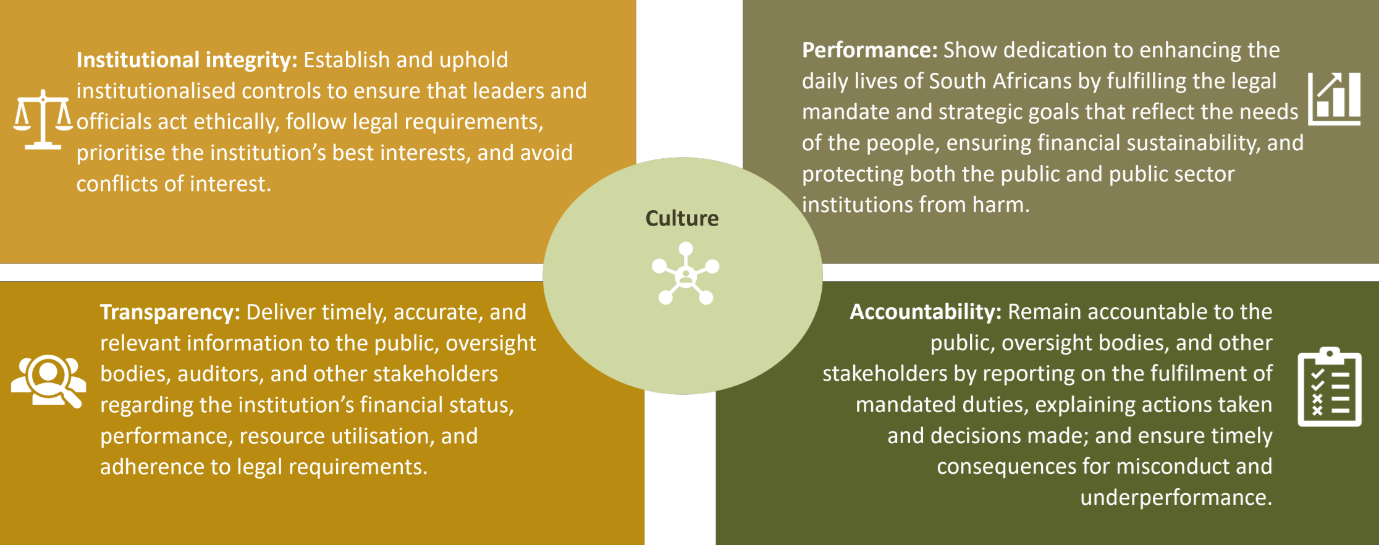
Source: AGSA, 2025
The 29 municipalities that have maintained clean audits since 2020/21 are characterised by strong financial controls, performance management systems, and compliance with legislation. Their well-functioning institutional environments provide a firm foundation for improving service delivery and building public trust. These municipalities are a reminder that hope lies not in speeches, but in doing the work, starting with the basics. The tools, policies, and laws are clear and in place. What is missing is the political will and collective action. Fixing local government does not require miracles, it requires commitment to fundamentals.
References
[1] State of Local Government Finances and Financial Management. 30 June 2023. Audit Outcomes of the 2021/22 financial year: Analysis Document. Available: https://mfma.treasury.gov.za/media_releases/the%20state%20of%20local%20government%20finances/Pages/default.aspx
[2] State of Local Government Finances and Financial Management. 30 June 2023. Audit Outcomes of the 2022/23 financial year: Analysis Document. Available: https://mfma.treasury.gov.za/media_releases/the%20state%20of%20local%20government%20finances/Pages/default.aspx
[3] Thirteen municipalities failed to submit their financial and performance reports by the legislated deadline
[4] Auditor-General South Africa (2025). Consolidated General Report on Local Government Audit Outcomes 2023-24. Available: https://www.agsa.co.za/Reporting/MFMAReports/MFMA2023-2024.aspx
[5] Reply by President Cyril Ramaphosa to the Debate on the State of the Nation Address. 20 February 2020. Parliament, Cape Town. Available: https://www.stateofthenation.gov.za/assets/downloads/SONA-Debate-Reply-2020.pdf
[6] State of the Nation Address. 6 February 2025. Cape Town City Hall. Available: https://www.stateofthenation.gov.za/assets/downloads/SONA_2025_Speech.pdf
[7] National Treasury, The Presidency. 2025. Operation Vulindlela Phase II: A second wave of reform for more rapid and inclusive economic growth. Available: https://www.stateofthenation.gov.za/assets/downloads/Overview_of_Phase_II_of_Operation_Vulindlela.pdf
[8] Professionalisation Framework for Local Government. 2013. Available: https://www.salga.org.za/Documents/Knowledge-products-per-theme/Municipal%20Capabilities%20n%20HR/SALGA%20Professional%20Framework%20for%20Local%20Government.pdf
[9] Ibid
[10] Brunette, R. (2024). Checking Political Discretion in Recruitment to South Africa’s Public Administration. Public Affairs Research Institute. Available: https://pari.org.za/wp-content/uploads/2024/12/20241211_CivilServiceReform_Brunette_WEB.pdf
[11] Republic of South Africa. Local Government: Municipal Systems Act, 2000. Available: https://www.gov.za/sites/default/files/gcis_document/201409/a32-000.pdf