

Driving to work can be a real pain. Traffic, minibus taxis, and morning radio music – you don’t need an economist to tell you that it’s not always fun. However, it may be useful to recall that the infrastructure and policies supporting these commutes are crucial components of an economy.
Transport is a fundamental requirement for economic growth and development. Simply put, people having the accessibility that transport provides is non-negotiable for any country or region wishing to promote socioeconomic development.
In South Africa, the role of transport is perhaps even more crucial given its low levels of economic growth (0.6% in 2024 (Stats SA, 2025)) and high levels of unemployment (official unemployment rate of 31.9% in the fourth quarter of 2024 (Stats SA, 2025)). As repeatedly confirmed by the South African Government, transport plays an undeniable role in enabling and catalysing socioeconomic growth and development (South African Government, 2025; South African Government, 2023). Going together with transport’s role in an economy is the role that urban development and cities have to play.
Cities are hubs of economic activity where businesses and jobs are created. Feeding on their own success, cities attract talented and skilled labour, leading to economies of scale (cost savings from improved and increased production), agglomeration, and localisation. The concentration of people and businesses results in infrastructure and service development. As cities grow, they support regions and even countries through their prosperity and productivity (World Bank Group, 2025; UN-HABITAT, 2011).
However, there is a disclaimer to be made. While cities can be amazing engines of growth and development, the considerable pace and scale of urbanisation involved in the movement of labour into cities comes with significant challenges; urban sprawl that hinders connectivity, constrained land and natural resources, increased greenhouse gas emissions, vulnerability to natural disasters, and unmet demand for more and better jobs. If strategic policies and actions are not in place from national and local governments to overcome such issues, urbanisation can turn cities from an engine of growth to a considerable socioeconomic issue. (World Bank Group, 2025)
South Africa’s urbanisation issue
In South Africa, it has been found that “urban immobility” stemming from the country’s apartheid era has not been sufficiently addressed over the last thirty years. This urban immobility has severely hindered the potential benefits of urbanisation for the country. As a result, while economic theory and evidence suggest that “well-planned and managed densification” has a positive influence on economic development, South Africa finds itself as an outlier where urbanisation now poses a challenge to overcome. (World Bank Group, 2024)
This didn’t happen overnight and can’t be attributed to just one cause.
Spatial segregation
Discussions around transport in South Africa directly tie into accessibility, and South Africa started their journey towards inclusive urbanisation severely on the back foot.
South Africa’s Apartheid regime ended over three decades ago. Unfortunately, its legacy has continued, particularly those stemming from its laws on spatial segregation. During Apartheid, the legal segregation of people based on their race dictated the areas they lived and worked in (Lawal, 2024). There still exists a physical divide in where people live based on their race. This not only results in spatial segregation but also in segregation across income groups and accessibility, which has been found to directly hinder marginalised and poorer communities in their access to job opportunities, education, healthcare, etc. (Hamann, 2024; Machebele & Weir-Smith, 2024).
South Africa’s spatial segregation stemming from the Apartheid regime, coupled with the low productivity levels found in the country’s informal sector, has been found to result in higher unemployment rates, further creating exclusion and perpetuating spatial segregation. Transportation and housing policies towards improving the country’s labour market may become key factors in addressing such issues. (Shah & Sturzenegger, 2022)
Urbanisation and Urban Immobility
“Urbanisation” is the increase in the proportion of a region’s/country’s people living in towns and cities. This typically involves the movement of people from rural areas to urban areas and occurs during a country’s development. (European Environment Agency, 2025)
While urbanisation is still a relatively new occurrence in human history, the movement of populations towards urban areas, especially over the past few decades, has been noteworthy and drastic. Globally, more people now live in urbanised areas than not, and the high rates of urbanisation are expected to continue (Ritchie, Samborska, & Roser, 2024)
South Africa has been no exception to this phenomenon. As reported by The World Bank Group[1], South Africa is a “mostly urban country” with three-quarters of its economic activities concentrated in urban areas, making it a “mostly urban country”. Figure 1 shows the trend of South Africa’s population from rural to urban areas from 2004-2023. The proportion of its population living in urban areas increased nearly 10 percentage points, from 58.88% to 68.82%. It is also interesting to note that there has been a 2.15 percentage point increase in the proportion of people living in South Africa’s largest city (Johannesburg), indicating that even within urbanisation, there is a trend towards certain economic hubs.
Figure 1: South Africa’s urban/rural/largest city populations
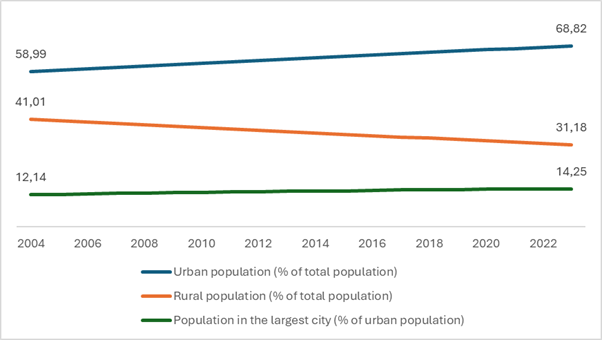
Source: Calculated using data from World Bank DataBank, 2025
This growth in urban population should also be viewed against the country’s increasing overall population rates, where South Africa’s population has increased by 29% since 2005 (from 48.99 million in 2005 to 63.21 million in 2023) (World Bank DataBank, 2025). This means that not only is a greater proportion of the country’s population living in urban areas, but also a greater total number of people.
However, urban mobility in South Africa is difficult for many. People without a car (approximately 80% of the population) and those who live in remote and impoverished neighbourhoods face additional challenges in moving to and around urban areas. For example, findings show that it can take a poor worker 2-3 hours to reach their workplace. (World Bank Group, 2024)
Clearly, from the high rates of urbanisation the country has seen, this issue of urban immobility will not only continue but perhaps worsen as a hindrance to inclusive growth.
Transport costs
Compared to global averages, South Africans spend more of their total household expenditure on transport than most other countries (Knipe & Krygsman, 2024). As of 2023, South African households were reportedly spending 15.3% of their total expenditure on transport (Stats SA, 2023).
Due to the diverse means of transport available to South Africans, it is difficult to directly compare the country to others. However, the World Bank International Comparison Program has ranked South Africa at 58 out of 165 countries in terms of its transport prices in 2021, suggesting that it is near the top third of countries based on the cost of transport (The Global Economy , 2025).
However, this ranking does not fully illustrate the high cost of transport in South Africa. As explained, South Africa is a country with high levels of inequality in access to transport. As a result, people living in rural or poorer areas face much higher transport costs to access work. This is illustrated by a World Bank Group study, which found that a “low-income” worker in South Africa will spend 51% of their net wage on transport costs a month. For comparison, the study finds that a low-income worker in Vietnam will spend only 10% of their net wage on transport costs a month. (World Bank Group, 2024)
Also worrying is the possibility that the already high transport costs in South Africa have been increasing over the past decade. A province-wide survey of Gauteng finds that residents are spending notably more on transport as of 2023/24 compared to 2017, even when taking inflation and increased costs of living into account (Thorne, 2024).
As of May 2025, an “inflation-based increase to fuel taxes in the country” was announced by Finance Minister Enoch Godongwana in the 2025 National Budget Speech (3.0), whereby levies on petrol would be raised “on petrol by 16 cents per litre and on diesel by 15 cents per litre” (Libera, 2025). Increasing the price of fuel, which is a critical input cost across the economy, will further increase the country’s transport and operational costs. In response, the Automobile Association (AA) of South Africa has raised concerns over the consequences of such an increase for the country’s consumers and economy. The association’s concerns are not unfounded, as they cite the high cost-of-living challenges already facing South African consumers through high food prices, increased electricity prices, and consistently high unemployment (AA, 2025). Other concerns with the fuel levy increases exist around its potential impact on the country’s poor, as illustrated by a lawsuit filed (and since dismissed) against the fuel levy increases by The Economic Freedom Fighters (EFF) (Bloomberg, 2025).
The opportunity cost of transport costs
High transport spending is an issue since it diverts spending away from potentially more productive avenues. Empirical evidence (Knipe & Krygsman, 2024) indicates that increased household expenditure on transport reduces the share of total household expenditure spent on food, housing, clothing, recreation (to a lesser extent than others) and education (to a lesser extent than others).
It isn’t a new concept that the more people spend on one thing, the less they can spend on others. However, this is important to remember in a South African context where a large share of the population needs to finance their high living costs with low levels of income[2]. Having high transport costs considerably adds to the costs of daily living, which detracts from the amounts people can spend on other potentially more productive avenues and the amounts people can put away for savings. From an individual consumer’s perspective, there is no benefit to spending a greater portion of their income on transport.
From an economic perspective, it can also be argued that transport is an inefficient sector to be receiving such high levels of spending based on its relative benefit for the national economy. Certain sectors other than transport are known to have very high multiplier effects on national income and employment, such as utilities and manufacturing. In the US, “Transportation and Warehousing” was found to have only the 11th highest jobs multiplier value, meaning that the addition of one job in 10 other sectors would create more employment in the national economy. (Tagliafierro, 2021)
In South Africa specifically, where nearly 70% of the country’s public commuters reportedly travel by minibus taxi (as of 2021) (Leech, 2021), the inefficiency of the transport sector is emphasised. The minibus taxi industry is unsafe and unregulated, leading to increased accident costs, and yet it extracts economic rent from a large and reliable consumer base due to the lack of alternative, affordable and available transport options (Jacobs, 2024). Furthermore, the industry is known to underpay or entirely evade tax payments (IOL, 2021). Clearly, as such a core component of South Africa’s transport sector, the minibus taxi industry can be thought of as much worse than just “inefficient”.
Unsuccessful transport policies
South Africa’s democratic government inherited significant challenges for its public transport policies due to the spatial segregation laws of and extreme levels of inequality from the Apartheid era (DBSA, 2025). To begin addressing these challenges, focus was given to urban development in the form of housing for poorer communities (such as through the Reconstruction and Development Programme (RDP)), which did see some success in the first decade after the end of Apartheid (Terreblanche, 1999; World Bank Group, 2024). However, since this initial success, poor spatial planning and lack of affordable public transport systems (particularly in rural and remote areas) have become common themes of the sector’s performance (DBSA, 2025; Mthombeni, 2024).
The South African transport policies from 1996-2021 have faced issues around an uneven and general lack of implementation, as well as a lack of adequate transportation planning and financing, resulting in the loss of market share to the minibus taxi industry (Walters & Pisa, 2023). The transport sector’s urban transit systems remain underdeveloped and costly, unsuccessfully contributing to the reduction of spatial inequalities. The country has also seen a rapid deterioration of its passenger rail system[3] (Williams, 2021), inadequate subsidisation of its commuter bus services (relative to urban growth), and the imperfect substitution of public transport systems (which stagnated or broke down) with privately owned, independently operated and weakly regulated transport services. (World Bank Group, 2024)
Recommended approaches
Addressing South Africa’s urban immobility and transport cost issue requires both long-term and short-term approaches. In the longer term:
- Efficient and adorable mass public transport needs to be better developed and integrated into urban transit systems. Essentially, more and better public transport is required. South Africa’s cities need well-functioning bus systems and ideally rail systems, and they need to be pedestrian-friendly to allow access. Minibus taxis should be better regulated and integrated into these systems. (World Bank Group, 2024)
- Distances need to be reduced between businesses, workers, and consumers. While there are advantages to having residential areas for houses and business areas for firms, the distinction between the two needs to be revisited to reduce the distances between people’s homes and their work. This will save costs, from fuel to time to time spent travelling. Discussions around the development of new cities and the relevant costs and benefits thereof can be tied into this point (Sikhakhane, 2022). (World Bank Group, 2024)
- The revitalisation of the country’s rail infrastructure must be done more effectively. President Cyril Ramaphosa has stated the importance of rail for the country’s transport sector and the urgent need to address issues in its development (Ramaphosa, 2024). The potential positive socioeconomic impact a well-functioning rail system can have in the country and the need for its prioritisation is echoed across numerous South African stakeholders (Mabuza, 2023; Cilliers, 2024; Seamaster, 2023).
All longer-term objectives should be appropriately tailored to the specific regions where the policies may be implemented. South Africa is a diverse country with diverse needs, and a one-size-fits-all approach won’t get the job done everywhere. Furthermore, policymakers must understand that these actions may not have immediate results but will require sustained effort, resources, and political commitment.
Of course, commuters cannot wait indefinitely for urban transport relief. In the short term, a World Bank Group report[4] promotes the following interventions as the most feasible, impactful, and timely:
- The appropriate allocation of grants from Treasury to PRASA to have better investment and performance.
- Providing vouchers to poor customers to reduce their transportation costs.
- Reducing the red tape involved in land development in dense areas.
- Having financial incentives for social housing projects in areas closer to businesses.
- Accelerating the development and use of digital spatial planning platforms which can provide information and manage development projects, including with the private sector.
Whatever transport policies and strategies are put in place in South Africa, long- or short-term, urban or rural, what is clear is the crucial need to follow through in the implementation thereof.
Conclusion
Urbanisation can be a driver of inclusive growth. However, in South Africa, it has become a barrier due to the country’s history of spatial segregation and unsuccessful urban transport policies over the past two decades. It is currently hurting the poorest in the country, and it isn’t showing any signs of stopping. Policymakers must act. However, they aren’t going into this battle blind as many studies have been done on transportation in South Africa, with clear findings-based recommendations often provided. What is required now is sustained commitment. And probably some good buses and trains.
[1] (World Bank Group, 2024)
[2] In 2018, 73.7% of the adult population in South Africa earned less than R6110 per month (BUREAU of Market Research, 2023).
[3] Stemming from the abolishment of an effective railway policing system in 1980, intensified through corruption and mismanagement since 2010
[4] (World Bank Group, 2024)
References
AA. (2025). AA Responds to Fuel Levy Increase: Calls for Transparency and Structural Reform. Retrieved from AA: https://aa.co.za/aa-responds-to-fuel-levy-increase-calls-for-transparency-and-structural-reform/#:~:text=AA%20Responds%20to%20Fuel%20Levy%20Increase%3A%20Calls%20for%20Transparency%20and%20Structural%20Reform,-May%2022%2C%202025&text=The%20Automobile%20As
Bloomberg. (2025). High court rejects EFF’s bid to stop fuel levy increase. Retrieved from News 24: https://www.news24.com/business/economy/high-court-rejects-effs-bid-to-stop-fuel-levy-increase-20250603-0931
BUREAU of Market Research. (2023). PERSONAL INCOME ESTIMATES FOR SOUTH AFRICA, 2018 – 2023. Retrieved from BUREAU of Market Research: https://bmr.co.za/2023/08/16/personal-income-estimates-for-south-africa-2018-2023/#:~:text=The%20analysis%20reiterated%20the%20existence,10.0%25%20of%20cash%20flow%20income.
Cilliers, V. (2024). RAIL SHOULD BE SA’S HIGHEST PRIORITY. Retrieved from SA Grain: https://sagrainmag.co.za/2024/07/02/rail-should-be-sas-highest-priority/
DBSA. (2025). How the current state of public transport impacts employment in South Africa. Retrieved from DBSA: https://www.dbsa.org/article/how-current-state-public-transport-impacts-employment-south-africa#:~:text=Public%20transport%20challenges,and%20development%20of%20transport%20infrastructure.
European Environment Agency. (2025). urbanisation. Retrieved from European Environment Agency: https://www.eea.europa.eu/help/glossary/eea-glossary/urbanisation
Hamann, C. (2024). Race still divides South Africa – study shows little transformation in new suburbs in country’s economic hub. Retrieved from The Conversation: https://theconversation.com/race-still-divides-south-africa-study-shows-little-transformation-in-new-suburbs-in-countrys-economic-hub-229738
IOL. (2021). R90bn taxi industry only paying R5m in taxes. Retrieved from IOL: https://iol.co.za/news/politics/2021-05-12-r90bn-taxi-industry-only-paying-r5m-in-taxes/
Jacobs, B. (2024). The South African minibus taxi industry: A picture of captive users and a lack of regulation. Retrieved from NWU: https://news.nwu.ac.za/south-african-minibus-taxi-industry-picture-captive-users-and-lack-regulation
Knipe, M., & Krygsman, S. (2024). The opportunity cost of household transport expenditure in South Africa. Journal of transport and supply chain management.
Lawal, S. (2024). South Africa: 30 years after apartheid, what has changed? Retrieved from ALJAZEERA: https://www.aljazeera.com/news/2024/4/27/south-africa-30-years-after-apartheid-what-has-changed
Leech, K. (2021). Taxi industry transports majority of South Africa’s public commuters, but exact number of passengers unclear. Retrieved from Africa Check: https://africacheck.org/fact-checks/reports/taxi-industry-transports-majority-south-africas-public-commuters-exact-number
Libera, M. (2025). 5 important takeaways from Budget 3.0. Retrieved from BusinessTech: https://businesstech.co.za/news/budget-speech/825082/5-important-takeaways-from-budget-3-0/
Mabuza, L. (2023). IMPORTANCE OF RAILWAYS ON SOUTH AFRICAN ECONOMY. Retrieved from Right for Education : https://rightforeducation.org/2023/04/21/railways-south-african-economy/
Machebele, P., & Weir-Smith, G. (2024). Exploring the role of spatial mismatch on educationalattainment in South African metropolitan areas: spatial dataanalysis. South African Geographical Journal.
Mthombeni, B. (2024). South Africa’s lack of an integrated transport system hinders freedom and equality. Retrieved from Mail&Guardian: https://mg.co.za/thought-leader/2024-07-18-south-africas-lack-of-an-integrated-transport-system-hinders-freedom-and-equality/#:~:text=In%20some%20rural%20or%20low,be%20quickly%2C%20easily%20and%20affordably.
Ramaphosa, C. (2024). Rail must be the backbone of public transport in South Africa. Retrieved from South African Government: https://www.gov.za/blog/rail-must-be-backbone-public-transport-south-africa?utm_source=chatgpt.com
Ritchie, H., Samborska, V., & Roser, M. (2024). Urbanization. Retrieved from Our World In Data: https://ourworldindata.org/urbanization
Seamaster. (2023). The Crucial Role of Rail Transport in Southern Africa’s Iron Ore Industry. Retrieved from Seamaster maritime and logistics : https://seamaster.co.za/southern-africas-iron-ore/
Shah, K., & Sturzenegger, F. (2022). Search, Transport Costs, and Labor Markets in South Africa. Growth Lab.
Sikhakhane, J. (2022). South Africa doesn’t need new cities: it needs to focus on fixing what it’s got. Retrieved from The Conversation: https://theconversation.com/south-africa-doesnt-need-new-cities-it-needs-to-focus-on-fixing-what-its-got-187873#:~:text=In%20his%202019%20state%20of,the%20country’s%20primary%20urban%20challenges.
South African Government. (2023). Transport – the lifeblood of our economy and society. Retrieved from South African Government: https://www.gov.za/blog/transport-lifeblood-our-economy-and-society
South African Government. (2025). Transport. Retrieved from South African Government: https://www.gov.za/about-sa/transport
Stats SA. (2023). Income and expenditure of households. Stats SA.
Stats SA. (2025). MEDIA RELEASE. Stats SA.
Stats SA. (2025). SA economy grows in the fourth quarter. Retrieved from Stats SA: https://www.statssa.gov.za/?p=18124
Tagliafierro, J. (2021). The Multiplier Effect: Which Industries are the Biggest Job Creators? Retrieved from camoin associates: https://camoinassociates.com/resources/the-multiplier-effect-which-industries-are-the-biggest-job-creators/
Terreblanche, S. (1999). THE IDEOLOGICAL JOURNEY OF SOUTH AFRICA FROM THE RDP TO THE GEAR MACROECONOMIC PLAN. University of Stellenbosch.
The Global Economy . (2025). Transport prices – Country rankings. Retrieved from The Global Economy : https://www.theglobaleconomy.com/rankings/transport_prices_wb/
Thorne, S. (2024). South Africans finding it more expensive to get around town. Retrieved from BUSINESSTECH: https://businesstech.co.za/news/motoring/800942/south-africans-finding-it-more-expensive-to-get-around-town/
UN-HABITAT. (2011). The economic role of cities. UN-HABITAT.
Walters, J., & Pisa, N. (2023). Review of South Africa’s public transport system. Research in Transportation Economics.
Williams, D. (2021). What broke South African rail — and can it be fixed? Retrieved from Daily Maverick: https://www.dailymaverick.co.za/article/2021-04-20-what-broke-south-african-rail-and-can-it-be-fixed/#:~:text=After%20five%20years%20as%20Prasa’s,its%20implementation%20can%20be%20monitored.
World Bank DataBank. (2025). DataBank. Retrieved from World Bank Group: https://databank.worldbank.org/
World Bank Group. (2024). Making cities engines of growth and economic inclusion. International Bank for Reconstruction and Development / The World Bank .
World Bank Group. (2025). Overview. Retrieved from Transport: https://www.worldbank.org/en/topic/transport/overview
World Bank Group. (2025). Urban Development. Retrieved from World Bank Group: https://www.worldbank.org/en/topic/urbandevelopment/overview#:~:text=By%20investing%20in%20urban%20infrastructure,to%20building%20more%20livable%20cities.